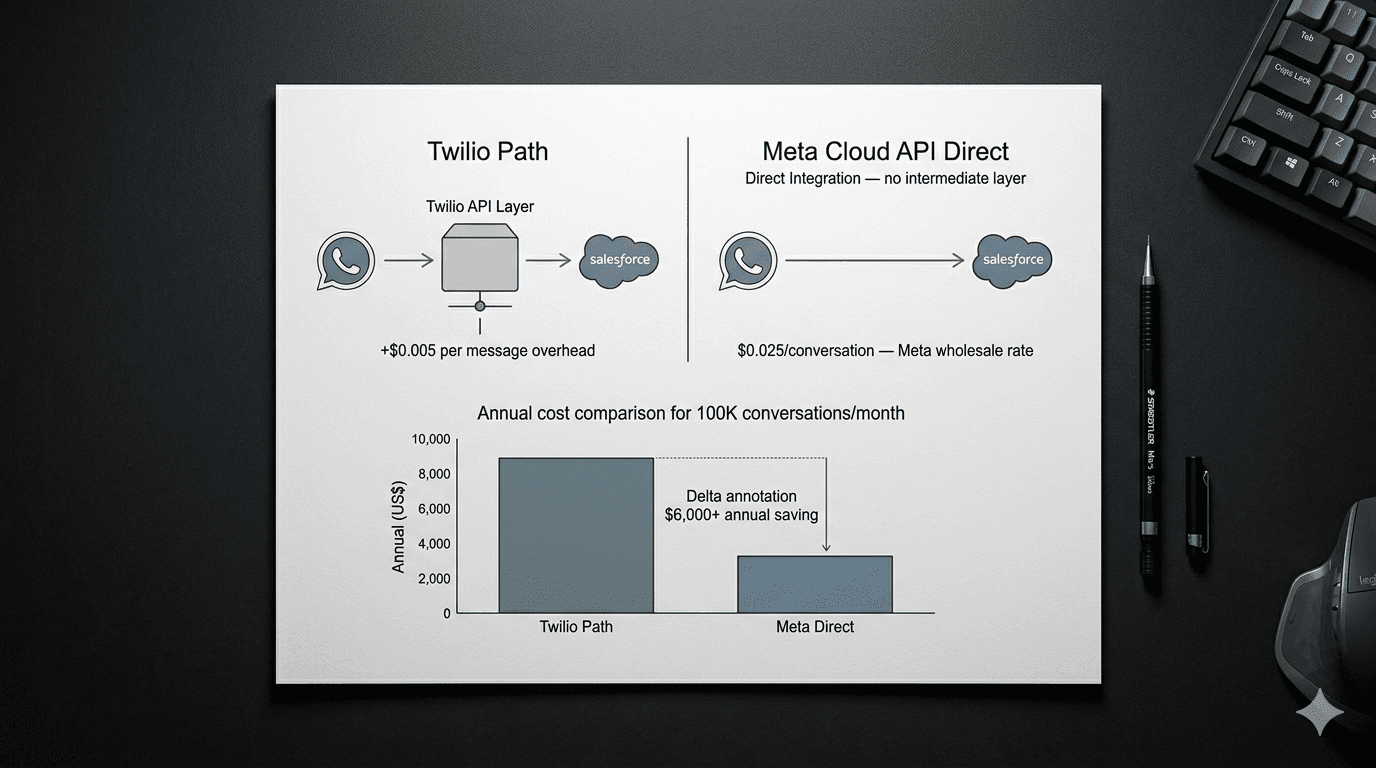
01Two Paths to WhatsApp in Salesforce: Twilio vs. Meta Direct
When implementing WhatsApp Salesforce integration with BYOK architecture, you face an immediate infrastructure decision: connect via Twilio's Messaging API, or connect directly to Meta's WhatsApp Cloud API? Both are valid, but they have meaningfully different cost structures, feature sets, and developer experiences.
Meta's WhatsApp Cloud API (also called WhatsApp Business API or Cloud API) is the direct path. You create a WhatsApp Business Account (WABA) in Meta Business Manager, get a Phone Number ID and a System User Access Token, and call Meta's API endpoints directly from Salesforce.
Twilio's approach routes through Twilio's Messaging API, which then connects to WhatsApp on your behalf. You get Twilio's developer experience, webhook infrastructure, and multi-channel capabilities — but add a layer between your Salesforce org and Meta.
02Pricing Comparison: Twilio vs Meta Direct WhatsApp API Rates 2026
Meta's WhatsApp Cloud API uses a conversation-based pricing model. Pricing differs by country and conversation category. As of 2026: in the US, business-initiated conversations cost approximately $0.025 per conversation. In India (the world's largest WhatsApp market): approximately $0.0066. In the UAE: approximately $0.014. The first 1,000 conversations per month are free.
Twilio passes through Meta's conversation rates but adds a per-message fee on top. Twilio's WhatsApp pricing includes the Meta conversation fee (passed through) plus approximately $0.005 per individual message sent or received. For a conversation involving 10 messages, that adds $0.05 in Twilio overhead above Meta's direct rate.
For SMS (not WhatsApp), Twilio offers highly competitive rates: $0.0079 per outbound SMS in the US. This is Twilio's core strength — its SMS infrastructure is mature, reliable, and cost-competitive. ConnectVogue supports both: you can use Meta API directly for WhatsApp and Twilio for SMS, with both channels unified in the same Salesforce console.
Bottom line: for WhatsApp, connecting directly to Meta's Cloud API via BYOK is cheaper at scale. For SMS, Twilio remains the industry-standard choice. ConnectVogue supports both simultaneously.
03Feature Matrix: What Each API Supports Inside Salesforce
WhatsApp Message Types — Both APIs support text messages, media messages (images, documents, videos), interactive messages (buttons, lists), and message templates. Meta's Cloud API additionally supports Flows (WhatsApp's native interactive forms), which are not yet available through Twilio's WhatsApp integration.
Message Status Webhooks — Both APIs provide delivery status updates (sent, delivered, read, failed). Meta's webhooks are more granular, providing a 'read' timestamp when the recipient opens the message. Twilio provides similar status callbacks but with higher latency (typically 200–500ms slower).
Phone Number Management — Meta's Business Manager allows managing multiple phone numbers under one WABA. Twilio provides phone number provisioning within their platform. For Salesforce BYOK, both are valid — you enter the phone number and credentials in Salesforce's Named Credentials.
Template Management — WhatsApp Message Templates (HSM) must be approved by Meta regardless of whether you use Twilio or Meta direct. ConnectVogue's template management feature syncs approved templates from your Meta WABA directly into Salesforce for use in bulk messaging — available for both API paths.
Reliability/SLA — Meta's Cloud API SLA guarantees 99.9% uptime. Twilio guarantees 99.95% uptime and provides a dedicated status page. For mission-critical Salesforce deployments, both meet enterprise reliability standards.
04Which Should You Choose? Decision Framework for Salesforce Teams
Choose Meta WhatsApp Cloud API (Direct) if: your primary channel is WhatsApp (not SMS); you want the lowest possible cost per conversation; you want access to the latest WhatsApp features (Flows, new interactive formats) without waiting for Twilio to add support; and your Salesforce developers are comfortable with REST API webhook setup.
Choose Twilio if: you need omnichannel SMS + WhatsApp on a single API credential; you want Twilio's proven webhook infrastructure and error handling; your team already has Twilio expertise; and you're operating at moderate message volumes where the per-message overhead is acceptable.
Choose Both (ConnectVogue's recommended architecture): use Meta Cloud API directly for WhatsApp (cheapest, most feature-rich) and Twilio for SMS. ConnectVogue supports both simultaneously in one Salesforce installation — your agents see WhatsApp and SMS threads side by side in the unified console, and your Flows can send to either channel.
This hybrid approach — direct Meta for WhatsApp, Twilio for SMS — is what most of our enterprise clients use in production. It optimises cost and features for each channel independently while presenting a unified interface inside Salesforce.
“The API you choose shapes your cost structure, feature access, and maintenance burden for years. Direct Meta for WhatsApp, Twilio for SMS, unified inside Salesforce with ConnectVogue — that is the architecture most enterprise teams land on for 2026.”
Frequently Asked Questions
What is the cost difference between Twilio WhatsApp and Meta Cloud API direct for Salesforce integration?
Which WhatsApp API gives lower latency and more features when connected natively to Salesforce?
Can I use both Twilio SMS and Meta WhatsApp API simultaneously in the same Salesforce org?
What are the pros and cons of Twilio vs direct Meta WhatsApp API for a BYOK Salesforce architecture?
Keep Reading
All InsightsWhat Happens to Your WhatsApp Data When You Use 360SMS? A GDPR and Data Residency Audit
Every inbound WhatsApp message routed through a middleware vendor makes that vendor a GDPR data processor. Here is exactly what that means for Salesforce teams in the EU, UK, and UAE — and how native architecture eliminates the risk entirely.
360SMS Alternative in 2026: Why Salesforce Teams Are Switching to BYOK Architecture
360SMS dominates the Salesforce AppExchange with 60,000+ users. But for scaling teams, BYOK architecture cuts messaging costs by 40–60%, keeps all data inside your org, and delivers multi-provider Agentic AI that 360SMS cannot match.