01Why Salesforce Teams Are Re-Evaluating 360SMS in 2026
360SMS is not a bad product. With over 60,000 users, 1,200+ AppExchange reviews, and a 4.98-star rating, it is the dominant WhatsApp and SMS messaging platform for Salesforce. If you are evaluating messaging apps for your Salesforce org, you will find 360SMS at the top of almost every list. That is exactly why this post exists.
The best-known option and the right option are rarely the same thing. Salesforce Admins, RevOps leaders, and CFOs at scaling companies are discovering that what worked at 5,000 messages per month becomes quietly expensive, architecturally risky, and AI-limited at 50,000 messages per month. Three specific triggers push teams to search for a 360SMS alternative in 2026.
First, the cost trigger. Messaging volume scales with business success — but so does the invoice. Teams that move from pilot to production messaging discover that per-message markup pricing compounds aggressively. The Salesforce Trailblazer Community and Reddit's r/salesforce are full of variants of the same post: 'We started with 360SMS, the pilot looked affordable, now we're sending 200,000 messages a month and the cost is hard to justify.' This is not a surprise — it is how reseller-model pricing works by design.
Second, the compliance trigger. Enterprise IT and legal teams in regulated industries — financial services, healthcare, legal services — are now routinely asking a question that was rarely asked two years ago: where do our customer conversation records physically go before they arrive in Salesforce? The answer for most middleware-based platforms, including traditional connector-model apps, is: through the vendor's server infrastructure. That answer fails GDPR Article 25 audits, triggers HIPAA data residency reviews, and blocks procurement approval in German and UAE enterprise orgs.
Third, the AI trigger. 2026 is the year that 'AI features' stopped being a differentiator and became a specification requirement. Every platform now claims AI. The question procurement teams are asking is not 'do you have AI?' but 'whose AI is it, where does it process my conversation data, and can I choose a different provider?' Single-vendor AI lock-in has become an evaluation criterion, not just a nice-to-have.
02The Per-Message Markup Problem: The Math You Are Not Seeing
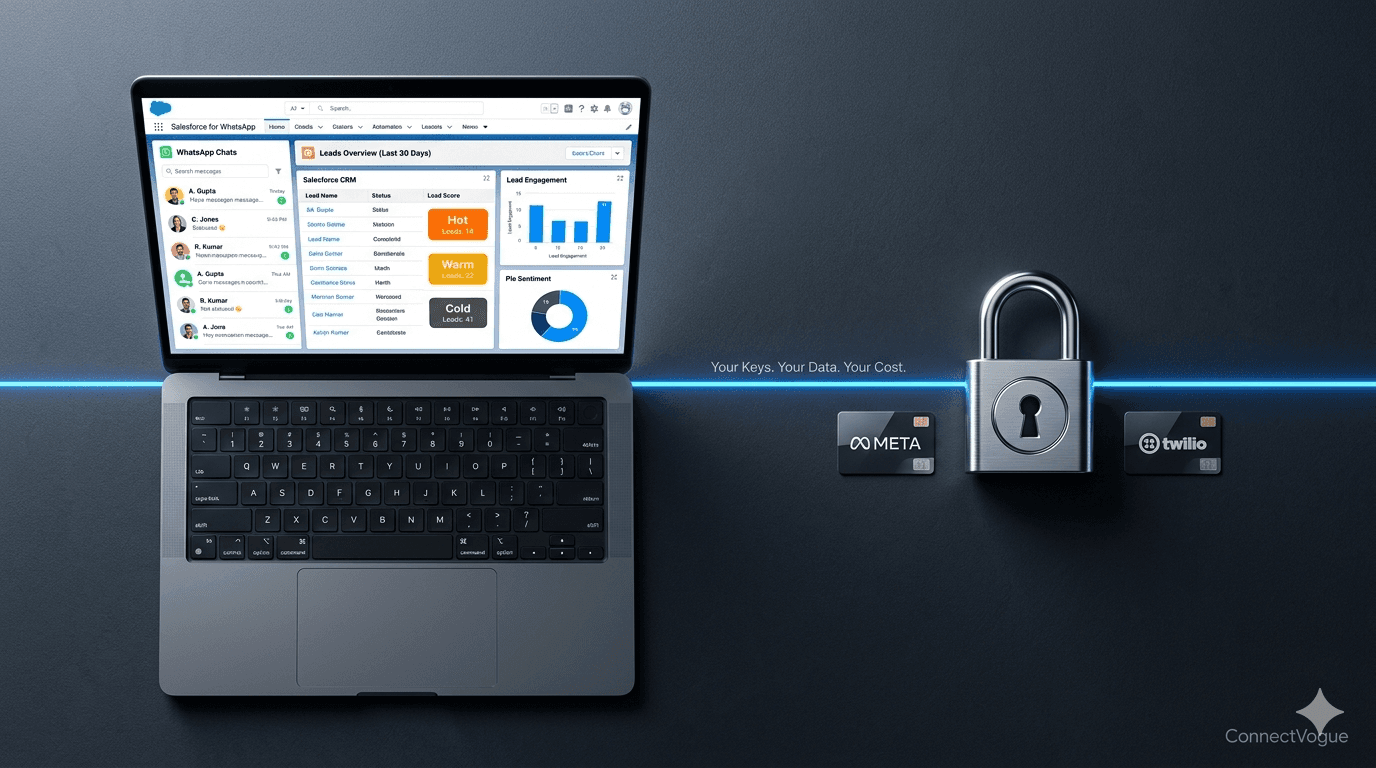
BYOK stands for Bring Your Own Key — the architecture where you connect your own Meta WhatsApp Business API credentials and your own Twilio account directly into Salesforce Named Credentials. The messaging vendor never touches your message traffic. You pay Meta and Twilio directly at wholesale rates. The software vendor charges only for the platform layer — the UI, the AI, and the automation engine.
The contrast with reseller-model pricing is stark. Meta's WhatsApp Cloud API charges for conversations, not individual messages. As of April 2026, a business-initiated conversation in the US costs approximately $0.025. In the UK: approximately $0.032. In the UAE: approximately $0.014. These are Meta's published wholesale rates — what you pay when you connect directly via the Cloud API.
Reseller-model platforms do not publish their effective per-message or per-conversation rates transparently. They bundle messaging costs into credit packs, monthly message limits, or per-seat pricing that obscures the actual carrier cost markup. Industry analysis and user reports consistently indicate effective markups of 2x to 4x wholesale rates for most established connector platforms.
Run the arithmetic at three realistic message volumes. A team sending 50,000 WhatsApp conversations per month pays Meta approximately $1,250 directly. At a 2x markup through a reseller: $2,500 per month — a $15,000 annual difference. At 250,000 conversations per month, the delta reaches $75,000 annually. At 1,000,000 conversations per month — common for enterprise sales and service teams in MENA and Southeast Asia — the gap exceeds $300,000 per year.
This is not a criticism of 360SMS's product quality. It is an observation about business model structure. Reseller pricing is how the platform generates revenue beyond software licensing. BYOK is how ConnectVogue generates revenue without extracting margin from your message volume. The question for every Salesforce RevOps leader is simple: at your current and projected message volume, which model serves your cost structure better?
03Where Does Your WhatsApp Data Go? The GDPR Question Every Enterprise Must Answer
When a customer sends your sales rep a WhatsApp message and that message eventually appears in Salesforce, there are two possible architectural paths it could have taken. Understanding which path your current platform uses is now a mandatory procurement question in the EU, UK, and UAE.
Path one: middleware architecture. The inbound WhatsApp webhook fires to the vendor's server. The vendor's server processes the message, extracts metadata, applies any transformations, and then writes the record into your Salesforce org via API. In this model, the vendor's server temporarily holds your customer's message content. The vendor is a data processor under GDPR Article 4(8). A valid Data Processing Agreement (DPA) must exist. The vendor's server infrastructure location matters — a US-based server processing messages from EU data subjects triggers GDPR Chapter V transfer rules.
Path two: native Salesforce architecture. The inbound WhatsApp webhook fires directly to a Salesforce Site endpoint inside your org. Salesforce processes the payload entirely within your org's trust boundary using Apex code. No external server touches the message. The vendor — ConnectVogue in this case — never receives or processes message content. We are not a data processor. Your customer's message travels from Meta's infrastructure to your Salesforce org. Full stop.
GDPR Article 25 mandates data protection by design and by default. A 100% native Salesforce architecture satisfies Article 25 structurally — there is no external processing to opt out of, because there is no external processing at all. For healthcare organisations with HIPAA obligations, native architecture ensures conversation data never leaves the data residency environment defined by your Salesforce org's data centre region.
The practical implication for enterprise procurement: if your vendor cannot confirm that inbound WhatsApp message content never touches their infrastructure, your legal team needs to review the DPA before the next renewal. German enterprise customers in particular are finding that middleware-based messaging platforms fail internal privacy audits that were not being conducted two years ago.
04The Agentic AI Gap: Multi-Provider Choice vs. Single-Vendor Lock
360SMS has introduced AI features. This is not a surprise — every serious platform in the Salesforce messaging space has added AI capabilities in 2025 and 2026. The meaningful differentiation is not whether AI is present but how the AI architecture is structured.
ConnectVogue supports four AI providers simultaneously: Google Gemini, OpenAI GPT-4, Anthropic Claude, and Salesforce Einstein. The active provider is configured per Salesforce org via a custom settings object, changeable at any time by an admin without reinstalling the package. Each provider is called via the customer's own API key, stored in Salesforce Named Credentials. The AI inference happens between your Salesforce org and the chosen AI provider — ConnectVogue's infrastructure is not in the chain.
Why does multi-provider AI architecture matter to enterprise buyers in 2026? Three reasons that are now driving procurement decisions. First, data sovereignty through the AI layer: when your conversation data is sent to an AI model for summarisation or lead scoring, that data leaves your Salesforce org temporarily. Which AI provider processes that data — and under what data processing terms — is now a legal and compliance question, not just a technical preference. Choosing your own provider means choosing your own data processor agreement.
Second, model selection by task type: GPT-4 and Claude perform differently on nuanced sales conversation analysis compared to Gemini's strengths in multilingual content. Salesforce Einstein is the preferred choice for organisations with Einstein Platform licences due to native trust layer integration. The right AI model for a Dubai-based enterprise selling in Arabic is not necessarily the right model for a US SaaS team qualifying English-language leads.
Third, cost control on AI inference: AI inference has a per-token cost. Locking into a single vendor's AI layer removes your ability to optimise the cost-performance trade-off as the AI market evolves. ConnectVogue's multi-provider model lets you switch providers as pricing and capabilities shift — without changing your Salesforce configuration.
Locking your AI into one provider in 2026 carries the same strategic risk as locking your message delivery into one carrier. The market is moving too fast for that kind of dependence to be comfortable.
05ConnectVogue vs. 360SMS: What the Comparison Actually Looks Like
A fair comparison requires acknowledging what 360SMS does well. 360SMS supports more than two messaging channels — it covers Instagram DM, Google Business Messages, LINE, and several other channels beyond WhatsApp and SMS. For organisations whose messaging strategy spans a genuinely broad channel mix, 360SMS's channel breadth is a legitimate advantage that ConnectVogue does not yet match.
On the dimensions that matter most for WhatsApp-primary and SMS-primary Salesforce orgs — the majority of the market — the comparison shifts. Per-message pricing model: 360SMS uses a credit or reseller model; ConnectVogue uses BYOK with zero markup. Data architecture: 360SMS uses server-side webhook processing; ConnectVogue is 100% native Salesforce with no external server. AI provider choice: 360SMS locks to their AI infrastructure; ConnectVogue supports Gemini, GPT-4, Claude, and Einstein via your own API keys. AppExchange pricing: 360SMS requires a paid licence; ConnectVogue is free to install with no licensing fee.
On Salesforce-native credentials: both platforms store configuration inside Salesforce, but the architectural difference is whether inbound message content routes through vendor servers. On Flow Builder support: both support Salesforce Flow automation. ConnectVogue provides five specific invocable Apex actions — Create Conversation, Send Message, Send Bulk Message, Generate AI Summary, and Get Messages — all callable from Flow Builder without code.
GDPR Article 25 compliance posture: 360SMS, as a middleware-based platform, requires a valid DPA and appropriate transfer mechanisms for EU data subjects. ConnectVogue's native architecture means no DPA with ConnectVogue is required for message content, because ConnectVogue never processes it. This distinction is increasingly decisive in enterprise procurement in Germany, the UK, and UAE free-zone companies with European data obligations.
The bottom line for a Salesforce Admin evaluating both: if your org sends more than 20,000 WhatsApp conversations per month, operates in a regulated industry, or is facing a GDPR or HIPAA review of your vendor stack, the BYOK + native architecture combination of ConnectVogue will outperform the 360SMS cost and compliance profile at every measurement point that matters.
06Who Should Stay on 360SMS — An Honest Answer
Any comparison post that does not tell you when NOT to switch is not a comparison post — it is a sales pitch dressed as analysis. ConnectVogue is not the right choice for every Salesforce org, and being specific about that is more useful to you than being vague.
Stay on 360SMS if your messaging strategy spans channels beyond WhatsApp and SMS. If Instagram DM, Google Business Messages, or LINE are active parts of your customer communication workflow, 360SMS's multi-channel breadth is a genuine capability advantage that ConnectVogue does not currently offer. Switching for WhatsApp and SMS savings while losing channel coverage is a poor trade-off.
Stay on 360SMS if your message volume is below 20,000 conversations per month and compliance is not a current concern. At low volumes, the absolute dollar difference in BYOK savings is real but modest. The switching cost — developer setup time for BYOK configuration, data migration, user retraining — may exceed the annual saving in year one. If the platform is working well at your current scale, the ROI case for switching is weak until volume grows.
Stay on 360SMS if you are mid-contract with significant prepaid credits and no compliance flag on the horizon. Running out a contract before evaluating alternatives is almost always the financially rational decision.
Evaluate ConnectVogue seriously if you are at renewal, scaling message volume, facing a GDPR or HIPAA vendor audit, frustrated with AI vendor lock, or looking to reduce SaaS spend while maintaining full WhatsApp and SMS capability inside Salesforce.
07How to Evaluate ConnectVogue Alongside 360SMS — The 30-Day Parallel Test
ConnectVogue is free to install from the Salesforce AppExchange. There is no licensing fee, no trial period, and no credit card required. The managed package installs in under ten minutes. Initial BYOK configuration — connecting your Meta WhatsApp Business API credentials and Twilio account to Salesforce Named Credentials — requires a one-time developer setup, typically two to four hours for an experienced Salesforce developer.
The most practical evaluation approach is a parallel install. ConnectVogue and 360SMS do not conflict inside the same Salesforce org. You can install ConnectVogue into a sandbox org, connect it to a dedicated WhatsApp number or a test Twilio account, and run it alongside your existing 360SMS configuration for 30 days. This lets you compare CRM data quality, conversation summarisation accuracy, Flow Builder integration behaviour, and actual messaging cost — using real production-equivalent traffic — before making any migration decision.
During the parallel evaluation, measure three things specifically. First, the cost delta: route a defined volume of test messages through ConnectVogue's BYOK path and compare the actual Meta and Twilio invoices against your equivalent 360SMS credit consumption. The saving will be visible within the first billing cycle. Second, data quality: compare the AI-generated conversation summaries from ConnectVogue against your current manual logging or 360SMS AI output. Third, compliance posture: ask your legal or IT security team to review ConnectVogue's native architecture documentation. The conversation about data residency should take under 30 minutes — there is nothing to review beyond 'all data stays in your Salesforce org.'
For teams in the US, UK, UAE, and Germany ready to run a parallel evaluation: install ConnectVogue free from the Salesforce AppExchange, connect your existing Twilio and Meta credentials, and run it for 30 days. The data will make the decision straightforward.
“The best-known option and the right option are rarely the same thing. If you are sending more than 20,000 WhatsApp conversations per month, operating in a regulated industry, or facing a vendor compliance review — BYOK architecture, native Salesforce data residency, and multi-provider Agentic AI will outperform 360SMS on cost, compliance, and intelligence simultaneously.”
Frequently Asked Questions
Is ConnectVogue completely free compared to 360SMS?
Can I run ConnectVogue alongside 360SMS before committing to a switch?
Does ConnectVogue support all the same WhatsApp features as 360SMS?
How much can I realistically save by switching from 360SMS to ConnectVogue?
What AI providers does ConnectVogue support, and is my conversation data sent to those providers?
Keep Reading
All InsightsWhat Happens to Your WhatsApp Data When You Use 360SMS? A GDPR and Data Residency Audit
Every inbound WhatsApp message routed through a middleware vendor makes that vendor a GDPR data processor. Here is exactly what that means for Salesforce teams in the EU, UK, and UAE — and how native architecture eliminates the risk entirely.
Agentic AI for Salesforce in 2026: Why Sales Reps Are Stopping Manual CRM Data Entry
Sales reps spend up to 20% of their week on manual CRM data entry. Agentic AI for Salesforce eliminates that entirely — turning every WhatsApp and SMS conversation into structured, automatic CRM updates across the US, UK, UAE, and Germany.